Love this? Save it for later!
Share the inspiration with your friends
I used to think desserts that looked like they belonged on a restaurant menu were simply out of reach for a home cook like me. You know the ones—elegant, perfectly plated, with that little dusting of something fancy on top. Honestly, I stuck to cookies and brownies for years because they felt safe. Then my neighbor Linda, who runs a tiny farmstand on her property every autumn, watched me fumbling with a bag of slightly bruised pears I’d bought from her for a bargain. She didn’t say anything at first. She just picked out the ripest one, walked me over to her outdoor sink, and started peeling it with a paring knife she pulled from her apron pocket. “You’re overthinking dessert,” she said, handing me the pear. “Poach it. Trust me.”
That afternoon, standing in her cluttered kitchen with late September light streaming through the window, I watched her transform those humble pears into something I still can’t quite believe came from such simple ingredients. She used cinnamon sticks she’d snapped herself from a branch in her yard, a bottle of wine she shrugged about (“Whatever’s open, dear”), and a spoonful of honey from the jar she kept on her counter with a cracked lid. She didn’t measure anything. When I asked her for the recipe, she laughed and said, “There’s no recipe. You just pay attention.” I’ve been paying attention ever since, and this version—my version—is what I keep coming back to. It’s the dessert I make when I want to feel like I’ve actually accomplished something in the kitchen without spending all day there.
Maybe you’ve been there, too. You want to make something that feels special, that impresses people, but you don’t want to pull out a mixer or deal with complicated steps. These Perfect Cinnamon Poached Pears with Mascarpone are exactly that. They look stunning, taste like a warm hug, and somehow make you look like you know exactly what you’re doing—even if you’re just following along like I was that first time. I keep making them because they remind me that the best recipes don’t come from perfection. They come from someone handing you a pear and saying, “Trust me.”
Why You’ll Love This Recipe
Let me tell you why this particular recipe has earned a permanent spot in my dessert rotation. I’ve tested it more times than I care to admit—sometimes on purpose, sometimes because I got distracted and let the pears simmer a little too long (spoiler: they were still delicious).
- Deceptively Simple: This looks like a dessert you’d order at a fancy restaurant, but the active prep time is maybe fifteen minutes. The poaching liquid does all the heavy lifting while you relax.
- Pantry-Friendly Ingredients: Pears, cinnamon, sugar, wine or juice, and mascarpone. That’s it. No obscure extracts or specialty items that require a trip to three different stores.
- Perfect for Entertaining: You can make these hours ahead of time. Actually, they taste better the next day. So when your guests arrive, you’re not stressed—you’re just scooping mascarpone and looking like a pro.
- Naturally Gluten-Free: No flour, no grains, no worries. This dessert works for pretty much everyone at the table.
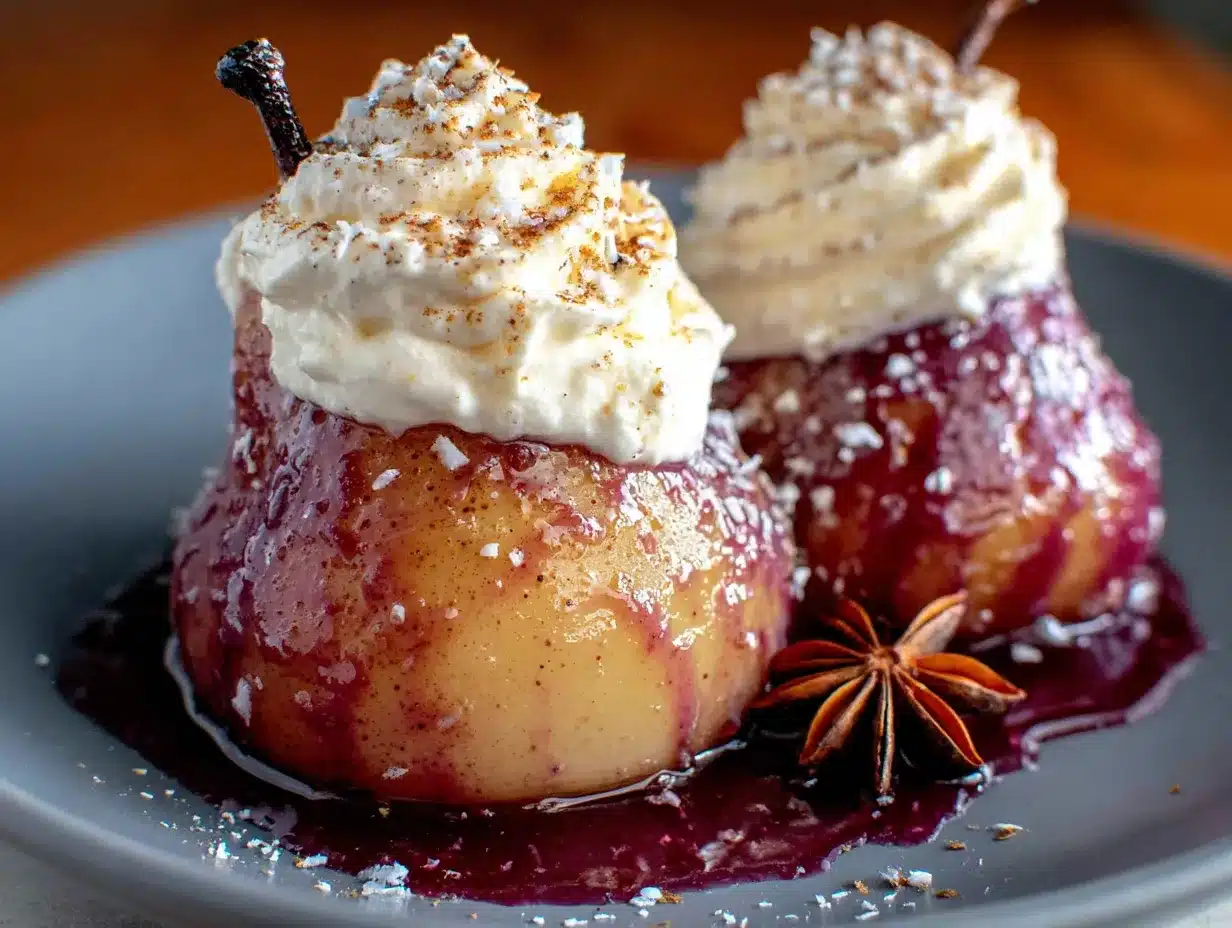
- Unbelievably Elegant: There’s something about a whole poached pear sitting in a pool of spiced syrup with a dollop of creamy mascarpone that just feels special. It’s comfort food dressed up for a night out.
What makes this version different from all the other poached pear recipes out there? It’s the balance. I spent weeks tweaking the cinnamon-to-sugar ratio, testing different poaching times, and figuring out exactly when to add the mascarpone so it doesn’t break. The result is a pear that’s tender but not mushy, sweet but not cloying, with a cinnamon flavor that warms you from the inside out. And that mascarpone? It’s not just a garnish—it’s the creamy, slightly tangy counterpoint that makes every bite complete. This isn’t just another dessert. It’s the one that makes you close your eyes after the first bite and forget about everything else for a minute.
What Ingredients You Will Need
This recipe uses simple, wholesome ingredients that come together to create something far greater than the sum of their parts. Most of these are probably already in your kitchen, which is exactly how I like to cook.
For the Poached Pears
- 4 firm but ripe Bosc or Anjou pears (Bosc holds its shape beautifully during poaching; Anjou is a close second. Look for pears that yield slightly at the neck when pressed gently)
- 4 cups water (or substitute with apple cider for a deeper autumn flavor)
- 1 cup granulated sugar (you can reduce to ¾ cup if you prefer a less sweet syrup—I’ve done both and they’re equally lovely)
- 3 cinnamon sticks (I prefer Ceylon cinnamon for its delicate, floral notes, but Cassia works perfectly too and is easier to find)
- 1 vanilla bean, split lengthwise (or 2 teaspoons vanilla extract added after poaching—vanilla beans give a more aromatic result)
- 4 whole cloves (optional but highly recommended for that subtle warmth)
- 1 strip of lemon peel (about 3 inches long, removed with a vegetable peeler—it brightens the whole syrup)
- Pinch of salt (don’t skip this—it balances the sweetness in a way you won’t notice until it’s missing)
For the Mascarpone Cream
- 8 ounces mascarpone cheese (room temperature—cold mascarpone won’t blend smoothly. I use the brand from my local Italian market, but any good-quality mascarpone works)
- 2 tablespoons honey (a mild wildflower honey or orange blossom honey adds lovely floral notes)
- 1 teaspoon vanilla extract (or the seeds from that vanilla bean you used in the poaching liquid—waste not, want not)
- Pinch of ground cinnamon (for garnish, plus extra for dusting)
A quick note on pears: I’ve made this with Bartlett pears when that’s all I could find, and they work but get softer faster. If you’re using Bartlett, reduce the poaching time by about 5 minutes. And whatever you do, don’t use overripe pears—they’ll turn into pear soup before you know it. I learned that one the hard way on a Tuesday night when I was trying to impress my book club.
Equipment Needed
You don’t need a fancy kitchen to make these pears. Here’s what you’ll actually use:
- A medium to large saucepan or Dutch oven (big enough to hold all four pears in a single layer without crowding—I use my 5-quart Le Creuset, but any heavy-bottomed pot works)
- A vegetable peeler (a Y-peeler is my favorite—it’s faster and gives you more control around the curves of the pear)
- A melon baller or small teaspoon (for removing the core from the bottom of the pear. If you don’t have a melon baller, a regular teaspoon works fine—just be gentle)
- A slotted spoon (for lifting the pears out of the hot liquid without burning yourself)
- A small bowl (for mixing the mascarpone)
- Serving plates or shallow bowls (something with a slight lip to hold the syrup)
If you don’t have a melon baller, honestly, just use a paring knife to carefully cut out the core. I’ve done it that way more times than I can count. And if you’re serving these for a dinner party, a wide, shallow bowl really lets the pears shine. I picked up a set of four from a thrift store for three dollars, and they look like they cost a fortune.
Preparation Method
Take your time with these steps. The actual hands-on work is minimal, but the pears need a little patience to reach perfection. Trust me, it’s worth it.
- Prepare the pears (5 minutes). Wash the pears gently. Using your vegetable peeler, remove the skin, leaving the stem intact—it adds a lovely visual touch. Starting from the bottom, use your melon baller or small spoon to scoop out the core, working upward carefully. You want to remove the seeds and the tough center without breaking through the sides. Leave the stem end intact. As you finish each pear, rub it with a little lemon juice to prevent browning.
- Make the poaching liquid (5 minutes). In your saucepan, combine the water (or apple cider), sugar, cinnamon sticks, vanilla bean (if using), cloves, lemon peel, and salt. Stir gently and bring to a boil over medium-high heat. Reduce the heat to low and let it simmer for 5 minutes, allowing the spices to infuse the liquid. The smell at this point is absolutely intoxicating—honestly, it’s half the reason I make this recipe.
- Poach the pears (25-35 minutes). Carefully lower the pears into the simmering liquid using your slotted spoon. They should be mostly submerged—if they’re not, you can add a little more water. Cover the pot partially with a lid and let them simmer gently. The key word here is gently—a rolling boil will break the pears apart. After 20 minutes, start checking for doneness by inserting a paring knife into the thickest part of a pear. It should slide in with minimal resistance but the pear should still hold its shape. Bosc pears typically take 25-30 minutes; Anjou might take a few minutes longer.
- Cool the pears (20-30 minutes). Once tender, use your slotted spoon to carefully transfer the pears to a plate or shallow dish. Let them cool to room temperature. Don’t throw away the poaching liquid! Let it simmer uncovered for another 10-15 minutes until it reduces to a syrupy consistency. This syrup is liquid gold—drizzle it over the pears when you serve them.
- Make the mascarpone cream (5 minutes). While the pears cool, place the room-temperature mascarpone in a small bowl. Add the honey and vanilla extract. Stir gently with a spatula until smooth and combined. Don’t overmix or the mascarpone can become grainy. Taste it and add more honey if you like it sweeter. Cover and refrigerate until you’re ready to serve.
- Assemble and serve (5 minutes). Place each cooled pear on a serving plate or shallow bowl. Spoon a generous dollop of mascarpone cream next to or on top of each pear. Drizzle the reduced poaching syrup over everything. Finish with a light dusting of ground cinnamon. Serve immediately or refrigerate for up to 2 hours before serving.
One thing I always forget to mention: when you’re scooping out the core, don’t worry if you leave a little bit behind. The poaching softens everything anyway, and honestly, nobody has ever complained about a tiny seed remnant. I once served these to my mother-in-law and didn’t realize until after she’d taken a bite that I’d left half the core in one pear. She said it was the best pear she’d ever had. So relax a little.
Cooking Tips & Techniques
After making these pears approximately twenty-seven times (I stopped counting after I lost track), I’ve collected a few hard-won tips that will make your life easier and your pears prettier.
Choose the right pear. This is the single most important factor. You want pears that are ripe but still firm—think of the texture of a just-ripe avocado. If the pear yields too easily at the neck, it’s too soft and will fall apart. If it’s rock hard, it won’t absorb the syrup properly. Bosc pears are my gold standard because they hold their shape beautifully and have that elegant elongated neck that looks so pretty on the plate.
Don’t rush the poaching. I know it’s tempting to crank up the heat, but low and slow is the way to go. A gentle simmer (tiny bubbles, not a full boil) ensures the pears cook evenly without breaking apart. I once tried to speed things up by boiling the pears aggressively, and within ten minutes I had pear mush swimming in cinnamon water. Not my finest moment.
Use a paper towel trick for even coloring. If you notice the tops of your pears aren’t submerged in the poaching liquid, place a crumpled piece of parchment paper or a clean paper towel directly on top of the liquid. It wicks the liquid up over the exposed parts of the pears, keeping them moist and evenly colored. This is a trick I learned from a pastry chef friend, and it works like magic.
Make the mascarpone ahead. The mascarpone cream actually benefits from sitting in the fridge for an hour or two—the flavors meld together and it firms up slightly, making it easier to dollop. Just take it out 15 minutes before serving to let it soften a bit.
Save the syrup. The leftover poaching syrup is incredible. I strain it and keep it in a jar in the fridge for up to two weeks. Drizzle it over yogurt, pancakes, or even vanilla ice cream. It’s also amazing in cocktails—a splash in sparkling wine or bourbon is next-level.
Variations & Adaptations
One of the best things about this recipe is how adaptable it is. Here are some variations I’ve tried and loved:
Wine-Poached Pears: Replace half the water with a dry red wine like Merlot or Pinot Noir. The color turns a gorgeous deep ruby, and the flavor becomes more complex. Add an extra tablespoon of sugar to balance the wine’s acidity. I made this version for a Christmas dinner once, and people literally asked for the recipe before they finished eating.
Dairy-Free Version: Swap the mascarpone with a thick coconut cream (chill a can of full-fat coconut milk overnight and scoop off the solid top). Mix it with a little maple syrup and vanilla—it’s surprisingly luxurious and completely dairy-free. My sister-in-law, who’s vegan, requests this version every time she visits.
Spiced Variation: Add a star anise, a cardamom pod (cracked open), and a small piece of fresh ginger (sliced) to the poaching liquid alongside the cinnamon. The warm, aromatic spices create a chai-like flavor profile that’s perfect for fall. I served this version at a Halloween party and it was gone before the punch.
Citrus Twist: Replace the lemon peel with an orange peel and add 2 tablespoons of orange juice to the poaching liquid. The orange-cinnamon combination is classic for a reason. Top the finished pears with a few fresh pomegranate seeds for color and a pop of tartness.
Honey-Rosemary Version: Replace the sugar with ¾ cup honey and add two sprigs of fresh rosemary to the poaching liquid. The herbal notes pair beautifully with the sweet mascarpone. This is my go-to for spring gatherings.
Serving & Storage Suggestions
These pears are stunning served at room temperature or slightly warm. I personally prefer them at room temperature because the flavors seem more pronounced. Arrange each pear on a shallow bowl or plate with a generous pool of the reduced syrup. Spoon the mascarpone cream alongside—don’t drown the pear in it; you want to see the beautiful shape. A light dusting of cinnamon over everything, and maybe a few toasted almonds or pistachios for crunch, and you’ve got a showstopper.
For drinks, these pears pair beautifully with a late-harvest Riesling or a dessert wine like Sauternes. If you’re serving them after a heavy meal, a cup of hot Earl Grey tea is a lovely, lighter option. I’ve also served them with a side of shortbread cookies for texture contrast—highly recommended.
Storage: Poached pears will keep in the refrigerator for up to 4 days. Store them in an airtight container with enough of the poaching syrup to cover them. The flavors actually deepen and become more complex over time, so don’t be afraid to make them a day or two ahead. The mascarpone cream should be stored separately and will keep for 3-4 days.
Reheating: To serve warm, gently reheat the pears in the poaching syrup over low heat for 5-7 minutes. Don’t microwave them—it makes the texture uneven. If you’re serving them cold, just let them sit at room temperature for 20 minutes before plating to take the chill off.
Freezing: I don’t recommend freezing the poached pears—the texture changes significantly upon thawing and becomes mealy. The mascarpone cream also doesn’t freeze well. These are best enjoyed fresh or within a few days of making.
Nutritional Information & Benefits
Per serving (one pear with about 2 tablespoons mascarpone cream and syrup), here’s the approximate breakdown:
- Calories: 320-350
- Fat: 14g (mostly from mascarpone)
- Carbohydrates: 48g
- Fiber: 5g
- Sugar: 38g (includes added sugar)
- Protein: 3g
- Sodium: 45mg
Pears are a great source of dietary fiber, particularly pectin, which supports digestive health. They also contain vitamin C, vitamin K, and copper. Cinnamon has been studied for its anti-inflammatory properties and its ability to help regulate blood sugar levels—though let’s be honest, with the sugar in this recipe, we’re not making a health food here. The mascarpone adds calcium and a little protein, plus a whole lot of deliciousness.
This recipe is naturally gluten-free and can be made dairy-free with the coconut cream substitution mentioned above. It contains no nuts unless you add them as a garnish. If you’re watching your sugar intake, you can reduce the sugar in the poaching liquid to ½ cup and use a sugar-free sweetener in the mascarpone—though I’ll be honest, the texture and flavor won’t be quite the same.
Conclusion
These Perfect Cinnamon Poached Pears with Mascarpone have become my secret weapon for every dinner party, holiday gathering, and quiet Tuesday night when I need a little something special. They remind me that you don’t need complicated techniques or a dozen ingredients to create something truly memorable. Sometimes all you need is a good pear, a little patience, and the willingness to trust the process.
I’d love to hear how these turn out for you. Did you try a variation? Use a different type of pear? Accidentally let them simmer too long and discover something new? Drop a comment below and let me know—I read every single one, and your experiments often inspire my next kitchen adventure. And if you share a photo on Pinterest or Instagram, tag me so I can see your beautiful creations. There’s nothing that makes me happier than knowing someone else is standing in their kitchen, paying attention, and falling in love with a simple pear.
Now go grab some pears. Trust me on this one.
Frequently Asked Questions
Can I use canned pears instead of fresh?
I wouldn’t recommend it. Canned pears are already cooked and much softer, so they’ll fall apart during poaching. The texture won’t be the same, and you’ll miss out on the beautiful infusion of cinnamon and spices. Fresh pears really are worth the few extra minutes of prep.
What if I don’t have mascarpone?
No problem! You can substitute with cream cheese (softened and mixed with a tablespoon of heavy cream to thin it out), or even a good-quality Greek yogurt for a lighter option. The flavor will be different, but still delicious. I’ve also used crème fraîche in a pinch, and it was lovely.
Can I make these pears ahead of time for a party?
Absolutely. In fact, I prefer making them a day ahead. The pears absorb more of the spiced syrup as they sit, and the flavors become deeper and more complex. Just store them in the syrup in the fridge, and make the mascarpone cream the day you plan to serve them.
My pears turned brown after peeling. What did I do wrong?
Nothing! Pears oxidize just like apples do when exposed to air. To prevent browning, rub the peeled pears with a cut lemon or dip them in a bowl of water with a splash of lemon juice. The poaching process will also even out the color, so a little browning before they hit the pot is totally fine.
Can I use ground cinnamon instead of cinnamon sticks?
You can, but I don’t recommend it. Ground cinnamon will make the poaching liquid cloudy and can leave a gritty texture on the pears. Cinnamon sticks infuse the liquid with a clean, aromatic flavor without the mess. If cinnamon sticks aren’t available, you can use a few strips of cinnamon bark or even a cinnamon tea bag in a pinch.
Pin This Recipe!
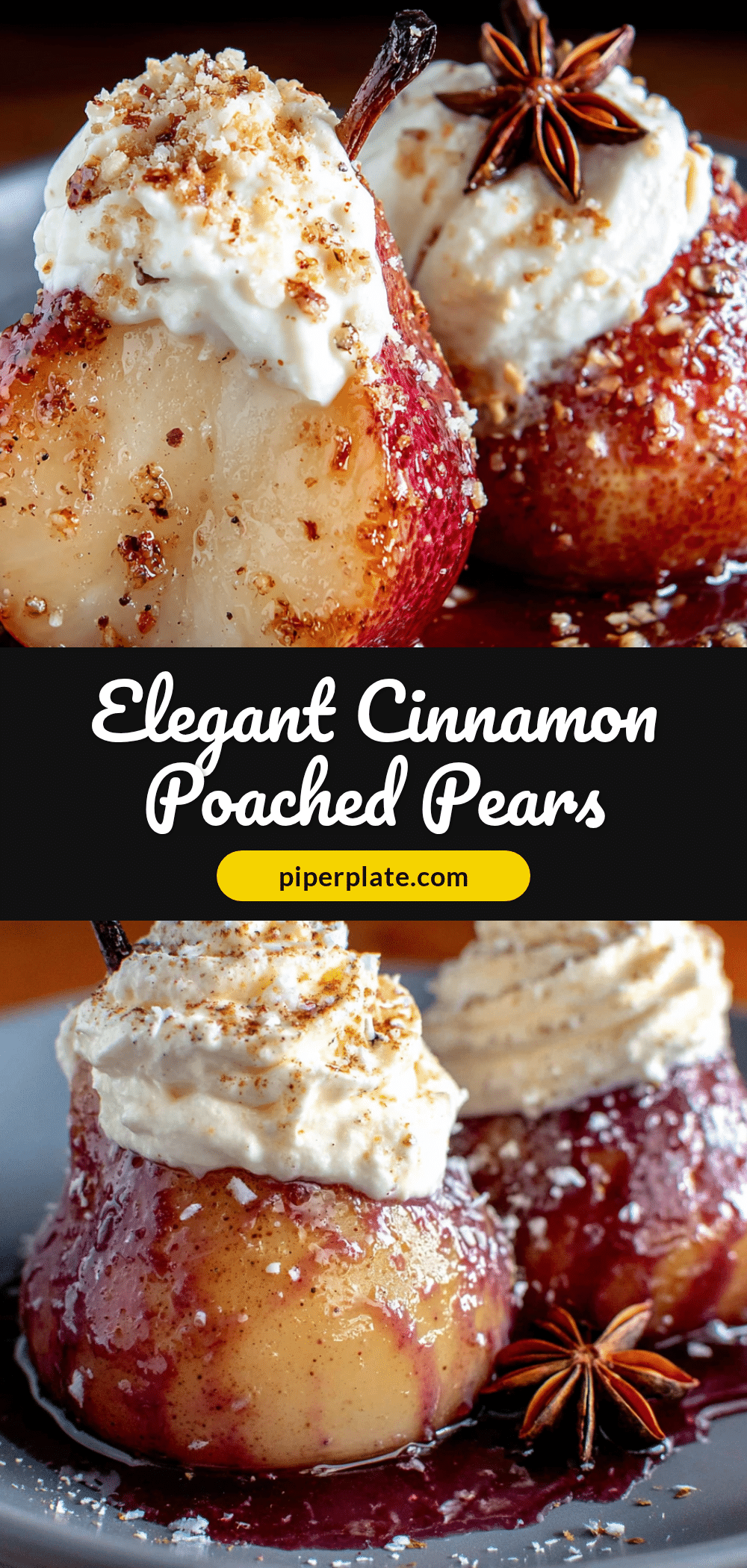
Perfect Cinnamon Poached Pears with Mascarpone
Elegant yet simple poached pears infused with cinnamon and spices, served with a creamy mascarpone dollop. This stunning dessert is naturally gluten-free and perfect for entertaining.
- Prep Time: 15 minutes
- Cook Time: 30 minutes
- Total Time: 45 minutes
- Yield: 4 servings 1x
- Category: Dessert
- Cuisine: American
Ingredients
- 4 firm but ripe Bosc or Anjou pears
- 4 cups water (or apple cider)
- 1 cup granulated sugar (or 3/4 cup for less sweet syrup)
- 3 cinnamon sticks
- 1 vanilla bean, split lengthwise (or 2 teaspoons vanilla extract)
- 4 whole cloves (optional)
- 1 strip lemon peel (about 3 inches)
- Pinch of salt
- 8 ounces mascarpone cheese, room temperature
- 2 tablespoons honey
- 1 teaspoon vanilla extract
- Pinch of ground cinnamon (for garnish)
Instructions
- Prepare the pears: Wash pears, peel with a vegetable peeler, leaving stem intact. Use a melon baller or small spoon to remove core from bottom, working upward carefully. Rub with lemon juice to prevent browning.
- Make the poaching liquid: In a saucepan, combine water (or apple cider), sugar, cinnamon sticks, vanilla bean, cloves, lemon peel, and salt. Bring to a boil over medium-high heat, then reduce heat to low and simmer for 5 minutes.
- Poach the pears: Carefully lower pears into simmering liquid using a slotted spoon. Cover partially and simmer gently for 25-35 minutes, until a paring knife slides in with minimal resistance. Bosc pears take 25-30 minutes; Anjou may take longer.
- Cool the pears: Transfer pears to a plate or shallow dish. Let cool to room temperature. Meanwhile, simmer poaching liquid uncovered for 10-15 minutes until syrupy.
- Make the mascarpone cream: In a small bowl, stir together room-temperature mascarpone, honey, and vanilla extract until smooth. Cover and refrigerate until ready to serve.
- Assemble and serve: Place each cooled pear on a serving plate. Spoon a dollop of mascarpone cream next to or on top of each pear. Drizzle with reduced poaching syrup and dust with ground cinnamon. Serve immediately or refrigerate for up to 2 hours.
Notes
Choose firm but ripe pears (Bosc are best). Don’t rush the poaching; a gentle simmer is key. For even coloring, place a crumpled piece of parchment paper on top of the liquid to wick it over exposed pear tops. The mascarpone cream can be made ahead and refrigerated. Leftover poaching syrup can be stored in the fridge for up to two weeks and used on yogurt, pancakes, or in cocktails.
Nutrition
- Serving Size: 1 pear with about 2
- Calories: 335
- Sugar: 38
- Sodium: 45
- Fat: 14
- Saturated Fat: 8
- Carbohydrates: 48
- Fiber: 5
- Protein: 3
Keywords: poached pears, cinnamon pears, mascarpone dessert, gluten-free dessert, easy elegant dessert, fall dessert, pear recipe